 BestPriceDeal.in

Most people who search for a habits book have already tried the big version of change. A strict 5 AM alarm, a gym membership paid for the whole year, a diary bought on January 1st. It lasts two weeks, then life gets in the way. Atomic Habits by James Clear is written for exactly that person, and it is one of the books people look up by name before buying: is it worth reading, and will it help if I already know the basics?
This review is based on the publisher’s description, the author’s own website and the published edition details. I have not read the book cover to cover for this post, so you will not find chapter-by-chapter claims here, only what the publisher and author say it covers.
Book details at a glance
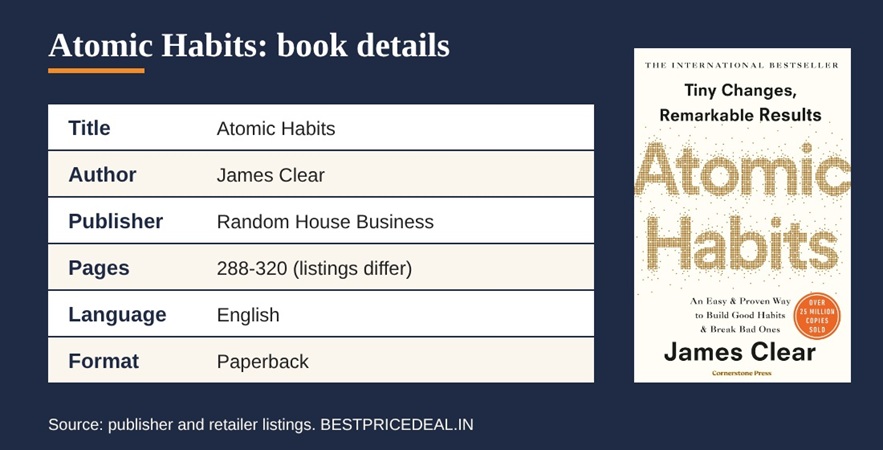
- Title: Atomic Habits (the Random House Business paperback is sold in India under the longer title “The Life-Changing Million Copy Bestseller”)
- Author: James Clear
- Publisher: Random House Business Books (Penguin Random House)
- Format: Paperback
- Language: English
- ISBN-10 / ISBN-13: 1847941834 / 978-1847941831
- Published: October 2018
- Pages: the Amazon.in listing shows 288, while Penguin’s own page shows 320. Page counts differ between listings, so treat the number as approximate.
What the book is about
The core argument, as the publisher puts it, is that small daily habits add up to large results over time, and that you do not need a dramatic overhaul to get there. Clear calls these tiny changes “atomic habits”. The publisher’s description names practical ideas such as habit stacking, the two-minute rule and the Goldilocks zone, and says the book draws on psychology and neuroscience along with stories of athletes, business leaders and scientists.
The author’s website adds a few more themes. It says lasting change depends more on the systems you build than on the goals you set, and that repeated failure usually points to a flawed approach rather than a lack of desire. Topics it lists include motivation and willpower, identity, finding time for a new habit, shaping your surroundings so good behaviour is easier, and getting back on track after a slip.
What looks strong, going by the published details
- A clear central idea. The “small changes compound” message is easy to explain in one sentence, which usually means the book stays focused.
- Practical tools are named up front. Habit stacking and the two-minute rule are things you can try the same evening, without waiting to finish the book.
- Wide use. The author’s page positions it for individuals, parents, teams and organisations, so it is not limited to one type of reader.
- Easy to find in India. It is stocked in English paperback by Indian sellers, so you can compare editions before ordering.
What to keep in mind
- It is a long-running popular title. If you have already read several habit or productivity books, parts of the advice may feel familiar. The publisher does not say how much is new compared with other books.
- Editions vary. Amazon.in lists many versions of the title: different publishers, hardbacks, translations and workbooks. Check that the one you add to the cart is the English paperback you want.
- A book will not build the habit for you. The description is about methods. Whether they work depends on whether you apply them.
- Page count and cover differ by listing, as noted above.
Who it suits, and who may skip it
It suits you if you start routines with energy and drop them within weeks, if you prefer practical methods over motivational speeches, or if you want one book to hand to a family member who wants to change a single habit, such as sleep or screen time.
You may want to skip it if you have already read it or a close cousin and just need to act, if you want a deep academic text on behavioural science (the publisher describes a general-reader book), or if you want exam preparation material.
How to choose a habits or self-help book
Start with the problem. If you cannot stick to routines, pick a book about systems and small steps. If you cannot focus, a book on attention and time will serve you better. For money habits, look at personal finance titles instead.
Next, read the publisher’s description and the table of contents, not only the star rating. Check whether the book offers methods you can try, or mostly stories. Look at the publisher, the edition and the format before ordering, since the same title can appear in several versions. Finally, set a small test: read the first chapter, try one idea for a week, and only then decide if you want the whole method.
If you are building a reading list around this theme, these posts on the site cover related ground: The 5 AM Club Book Review looks at morning routines, Make Time Book Review is about focus and productivity, and The Science of Self-Learning covers learning on your own. You can browse more in the Books & Review category.
Frequently asked questions
Is Atomic Habits worth reading? According to the publisher and the author’s site, it is a practical guide to building good habits and breaking bad ones through small changes. If that matches your problem, it is a reasonable pick. If you have read similar books, check the description first to see whether it adds anything for you.
Who is the author of Atomic Habits? James Clear. The publisher describes him as an expert on habits and decision-making.
Is Atomic Habits suitable for beginners? The publisher presents it for general readers rather than specialists, so you do not need any background in psychology to start.
Which edition of Atomic Habits should I buy in India? The edition covered here is the English paperback from Random House Business, ISBN 1847941834. Other editions exist, so match the ISBN on the product page before you order.