 BestPriceDeal.in
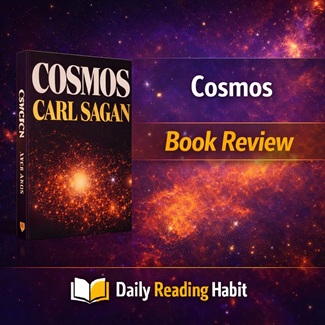
Cosmos by Carl Sagan Review: Does a 45-Year-Old Science Book Still Hold Up?
Short version: yes, almost unreasonably so — and the parts that don’t hold up are more interesting than most books’ best chapters.
Cosmos came out in 1980 alongside the TV series of the same name, back when Carl Sagan was essentially the person who convinced an entire generation that space was worth caring about. I went into this rereading it as an adult expecting nostalgia. What actually struck me is how much of it reads like it could’ve been written last year — and how a small handful of parts are charmingly, obviously stuck in 1980.
The Idea That Actually Sticks With You: The Cosmic Calendar
If you remember one thing from this book after you’ve forgotten everything else, it’ll probably be Sagan’s Cosmic Calendar — compressing the entire 13.8-billion-year history of the universe into a single calendar year. The Big Bang happens January 1st. Human beings show up in the last few seconds of December 31st. All of recorded human history fits into the final minute before midnight.
It’s a simple trick, but it’s the kind of idea that actually recalibrates how you think, not just something you nod along to and forget. This is Sagan’s whole gift in one device: taking a number too big to feel — 13.8 billion years — and making it visceral.
Where the Book Is Genuinely Moving, Not Just Informative
The chapters on the Library of Alexandria and Eratosthenes calculating Earth’s circumference using nothing but shadows and geometry are some of the best popular-science writing I’ve read, period. Sagan isn’t just explaining what Eratosthenes figured out — he’s mourning what was lost when the Library burned, and making a case for why that loss still matters to us specifically, today. That’s a harder trick than it sounds: turning a 2,000-year-old historical footnote into something that feels urgent.
His line about humans being made of “star stuff” — that the calcium in your bones and the iron in your blood were forged in dying stars — isn’t just a nice turn of phrase. It’s doing real argumentative work: collapsing the distance between “the universe” as an abstract concept and your actual body. Few science writers manage that without it feeling like a slogan.
Where It’s Visibly a Product of 1980
Here’s the honest part: some of it is dated in ways that are actually kind of fascinating rather than just annoying. The extraterrestrial-life sections lean on the Drake Equation with confidence that reads very differently now that we’ve actually found thousands of exoplanets since — Sagan was speculating in a near-total vacuum of data that we don’t have anymore. And the Cold War nuclear-anxiety passages, written at genuine height-of-tension 1980, land oddly resonant again rather than quaint, which says more about the current moment than about the book.
If you want a science book without that generational fingerprint — something written with today’s data — our review of A Brief History of Time sits in a similar “big questions, general audience” lane, just from a physicist’s angle instead of an astronomer’s, and without the 1980-specific baggage.
Who Should Read This
- Anyone who’s never read Sagan and wants to understand why he’s still cited as the reason people got into astronomy.
- Readers who want science writing with genuine literary ambition, not just clear explanation.
- People curious what “serious but accessible” science writing looked like before it became its own crowded genre.
Who Should Skip It
- If you want current astrophysics or exoplanet science, this is a historical document on that front, not a reference.
- If dated Cold War framing pulls you out of a book, be aware it shows up more than once here.
Verdict: 4.7/5
Not a 5 — the extraterrestrial-life speculation and some Cold War framing genuinely show their age — but it’s close, because the writing itself, especially the Cosmic Calendar and the Library of Alexandria sections, is some of the best popular science prose that exists. Forty-five years on, it’s aged more like a good piece of writing than like outdated data, which is the rarer thing to pull off.
Buy Cosmos here: GET DEAL — ₹377 (was ₹599)