 BestPriceDeal.in
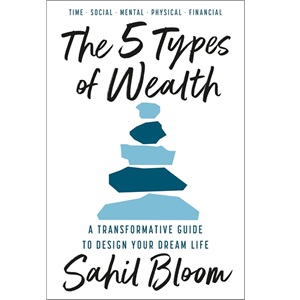
The 5 Types of Wealth by Sahil Bloom Review: Genuinely Useful Framework, or Repackaged Advice With Great Marketing?
Here’s something worth knowing upfront: this book has one of the more star-studded blurb lists you’ll see on a self-help title. Tim Cook, Bill Ackman, Mel Robbins, Andrew Huberman — a genuinely notable roster of endorsers. That’s either a strong signal of real quality, or evidence of a very well-connected author with a big platform (Sahil Bloom writes a widely-read newsletter, The Curiosity Chronicle). Probably it’s some of both, and worth knowing before you decide how much the hype should influence your purchase.
What the Book Actually Argues
Bloom’s framework splits wealth into five categories: Time, Social, Mental, Physical, and Financial — the argument being that a life optimized purely for financial wealth while neglecting the other four isn’t actually a wealthy life, whatever your bank balance says. He built this after three years of research and, by his account, thousands of interviews, and the book leans on real storytelling and cited research rather than pure motivational assertion.
The Genuinely Fair Criticism Worth Knowing
Real reader reviews raise a pointed, specific objection that’s worth taking seriously rather than dismissing: Bloom made his money early, in his 20s, and some readers find it hard to take “don’t over-prioritize financial wealth” fully seriously from someone advising it from a position of already having secured that wealth. That’s not an unfair criticism — it’s a legitimate question about whether the advice is equally applicable to someone still building financial security versus someone who’s already arrived.
There’s also a recurring, more general complaint: several readers describe the content as a competent repackaging of ideas already well-covered elsewhere (they specifically point to The 7 Habits of Highly Effective People as covering similar ground), rather than something conceptually new. That doesn’t necessarily make it bad — repackaging genuinely useful ideas into a clearer framework has real value — but go in knowing you may recognize a lot of it if you’ve read broadly in this space already.
Where It Actually Delivers
To be fair to the book: even critical reviewers tend to agree the core five-category framework itself is a genuinely useful mental model, even when they find the supporting arguments less fresh. Having a name for “time wealth” or “social wealth” as distinct, trackable categories — rather than just a vague sense that money isn’t everything — is a real, practical reframing tool, independent of how original the underlying advice is.
Who Should Actually Read This
- Readers who haven’t read much in this space and want a clear, well-organized starting framework.
- Anyone who wants the framework itself more than novel underlying advice — the five-category lens is useful even where the specific tips are familiar.
- Fans of Bloom’s newsletter or podcast appearances who want the fuller treatment of his ideas.
Who Should Skip It
- If you’ve already read widely in the self-help/personal-development space, expect real overlap with books you may have already read.
- If the “wealthy person tells you money isn’t everything” framing bothers you on principle, that’s a real, recurring reader objection worth weighing before buying.
Verdict: 3.9/5
The framework itself earns its popularity — it’s a genuinely clarifying way to think about a well-rounded life. But the celebrity-endorsement marketing outpaces how original the underlying content actually is, and the “already-rich guy” credibility question is a fair one to sit with before buying in fully.
Buy The 5 Types of Wealth here: GET DEAL — ₹365 (was ₹599)