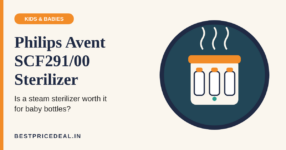
Philips Avent SCF291/00 Sterilizer Review: Is a Steam Sterilizer Worth It for Baby Bottles?
 BestPriceDeal.in

Boiling bottles in a steel pot works. It also means standing near a hot stove, fishing out wet teats with a spoon, and doing it again a few hours later. Parents who have done this for a few weeks usually start wondering if a countertop steam sterilizer is worth the space. The Philips Avent SCF291/00 is a well-known Philips model for that job, so here is what its specifications say and who it actually suits.
This review is based on Philips’ published specifications, not on hands-on use. I have not tested the unit myself.
What it is
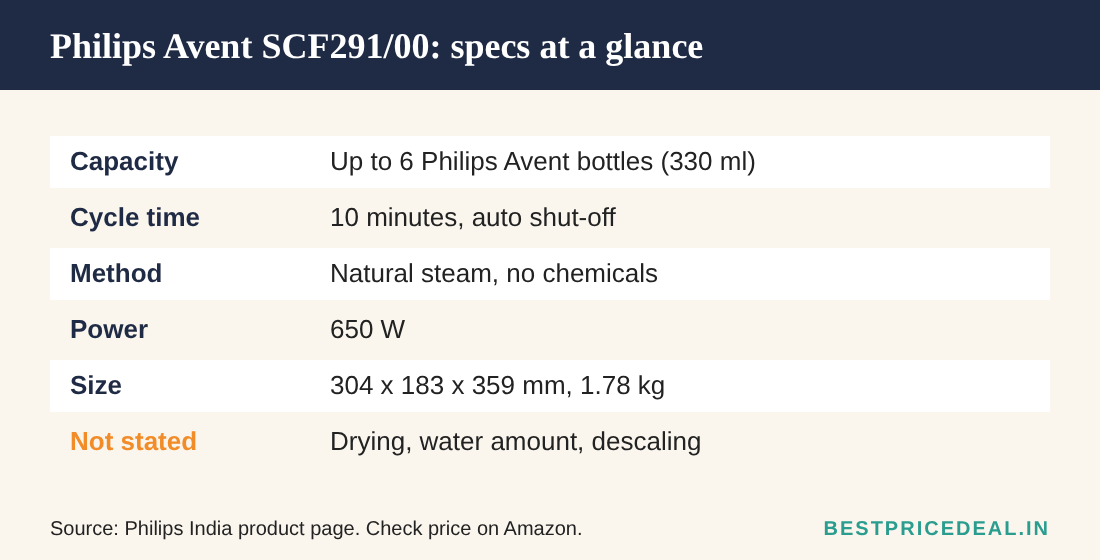
The SCF291/00 is an electric steam sterilizer. You put the items inside, add water, switch it on, and it runs a 10-minute cycle. Philips describes the process as chemical-free, using natural steam. When the cycle ends, the unit shuts itself off.
It is made of plastic (PP), weighs 1.78 kg and measures 304 x 183 x 359 mm. Power draw is 650 W. The box holds the sterilizer and one pair of tongs. Philips lists it as suitable from 0 to 6 months, which is a recommended stage rather than a hard limit, since older babies still use bottles, sippy cups and teethers.
Specs that matter
Capacity is the number most parents ask about first. Philips says it holds up to six Philips Avent baby bottles (330 ml) in one cycle. That covers a full day of bottle feeds for many families, though not every family.
The cycle time is 10 minutes. After it finishes, Philips says items stay sterile for up to 24 hours if the lid stays on. The shop page does not give a footnote for that 24-hour figure, so treat it as the brand’s claim.
On germs, the page says the unit kills 99.9% of them. A footnote says this comes from an independent lab test in 2021 and names the microbes tested, including E. coli, Staphylococcus aureus, Salmonella enterica and Listeria monocytogenes. That is more detail than most product pages give, but it is still the brand’s own commissioned test.
There is an integrated drip tray that protects the heating plate from milk droplets. Philips says the heating plate is easy to clean. The design is described as modular, so it can adapt to smaller items and take less counter space when not in use.
Besides bottles, it can handle pacifiers, sippy cups, utensils, toys, breast pump parts and teethers. Compatibility is listed as the Philips Avent range. Other brands may fit, but I did not find that stated, so measure before assuming.
Pros and cons from the specs
What works in its favour:
- Six-bottle capacity in a single 10-minute cycle
- Automatic shut-off at the end of the cycle
- No chemicals or tablets needed
- Handles more than bottles: pacifiers, pump parts, teethers
- Drip tray to keep milk residue off the heating plate
What to think about before buying:
- It does not appear to dry items. The pages I read do not mention drying, so expect to let parts air dry or wipe them with a clean cloth. Check the manual.
- The pages do not state how much water to use or how to descale it. If your tap water is hard, ask about this before you buy.
- Warranty terms are not on the product page; they link to a separate policy.
- At 304 x 183 x 359 mm it takes real counter space, even with the modular design.
- Compatibility is listed for the Philips Avent range, which matters if your baby uses another brand of bottle.
Who it suits, and who can skip it
It makes sense for a newborn household that goes through many bottles a day: mothers who pump, families where grandparents or a nanny share the feeding, or parents who simply do not want to boil water several times a day. It also helps if you use Avent bottles already, since compatibility is listed for that range.
You can probably skip it if your baby is mostly breastfed with a bottle once a day, if you have very little kitchen space, or if you are happy with a pot and a good routine. Boiling is the older method many families still use, so a sterilizer is mostly a convenience purchase. Ask your paediatrician how long and how often you need to sterilize for your baby’s age.
How to choose a sterilizer
Start with how many bottles you wash each day. If it is more than six, the cycle count matters more than the machine, because you will be running it twice. Next, check that your own bottles fit; a sterilizer built for one brand may leave gaps or tip other shapes. Then look at counter space, because the unit will sit out if you use it daily. Finally, ask whether you need drying built in. Some models include it and some do not, and it changes how quickly you can put things away. For Kids & Babies picks as we add them, see the Kids & Babies section.
If you are also setting up the house for the colder months, our guide to air purifiers for Indian homes covers room-size matching. And if someone at home also tracks blood pressure, we reviewed the Omron HEM-7120 separately.
FAQ
How long does the Philips Avent SCF291/00 take to sterilize? Philips lists a 10-minute sterilization cycle, after which the unit turns itself off.
How many bottles does it hold? Up to six Philips Avent baby bottles of 330 ml per cycle, according to Philips.
Does it dry the bottles? The pages I read do not say. Check the user manual or the Amazon listing before assuming it does.
Is it only for newborns? Philips lists 0 to 6 months as the recommended stage, but it also lists sippy cups, utensils, toys and teethers, so it stays useful as your baby grows.
I have covered what the published specifications say, and left out anything the brand did not state. Before buying, read the current listing and recent customer reviews on Amazon, and check how it stands against your own bottles and routine.