 BestPriceDeal.in

Every year around the end of October, the same thing happens in a lot of Indian homes. The festival lights go off, the crackers leave their smoke behind, the mornings turn hazy, and somebody in the family starts coughing at night. That is usually the week people open a shopping app and type “air purifier”. Then they see forty near-identical white boxes, each promising 99.97% filtration, and have no idea which numbers actually matter.
Here is the short version of what matters: the room you will use it in, the clean air delivery rate (CADR), how loud it is on its lowest setting, and what the replacement filters cost over the years. Everything else is packaging. Below are four purifiers sold on Amazon.in, with the specifications I could confirm from the brands’ own pages or retail listings, followed by a plain way to choose between them. If you are also planning around the festival sales, our Great Indian Festival 2026 shopping guide covers how bank offers work, and the daily deals page is where we keep the running list.
Xiaomi (Mijia) Smart Air Purifier 4 Compact
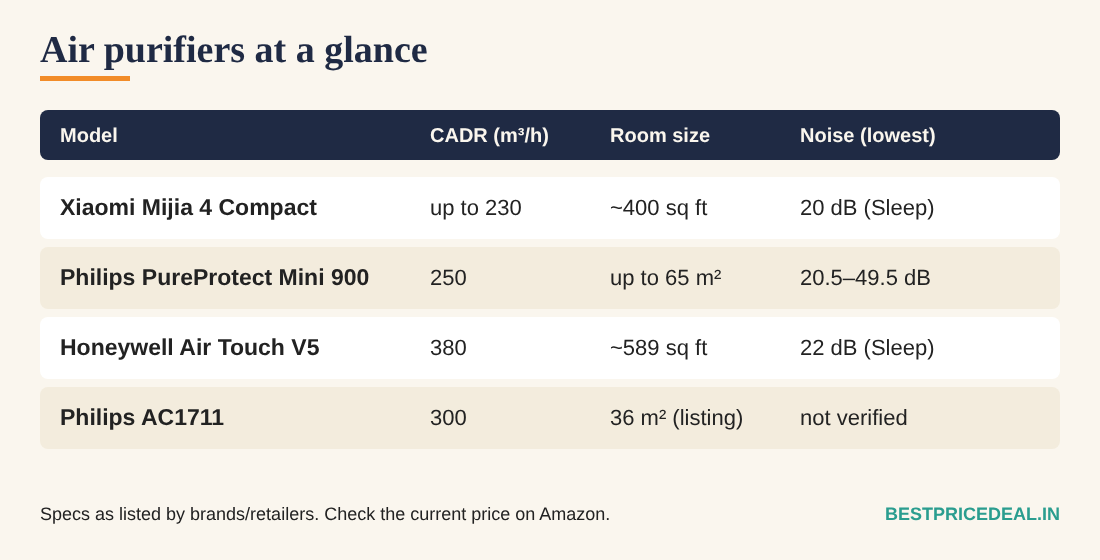
This is the small, tidy one, and the one I would look at first for a bedroom or a study. Xiaomi’s India page lists a particle CADR of up to 230 m³/h, a three-layer filter (primary filter, a high-efficiency filter and activated carbon) and coverage of about 400 sq ft. Noise drops to 20 dB, but only in Sleep mode, so expect more sound in Auto or Manual. It draws roughly 27 W.
What I like: you can run it from the Xiaomi Home app, it shows filter life, and the filter swap is a twist-and-pull job you can do yourself. Voice control works with Alexa or Google Assistant, but you need a separate smart speaker for that.
What to think about: it is meant for one room, not a whole flat. If your living room is large and the doors stay open, it will struggle to keep up. People who want a purifier that works without an app should also note that several features lean on the phone.
Philips PureProtect Mini 900 Series (AC0950/10)
Philips lists this one with a CADR of 250 m³/h and suggests it for rooms up to 65 m², which is a generous claim for a unit this size, so treat it as the upper limit and not the everyday figure. It uses a three-layer system with a pre-filter, a HEPA NanoProtect filter and activated carbon, and the recommended filter change is once a year (the replacement is the FY0910/30).
The noise range is wide: about 20.5 dB in Sleep mode and up to 49.5 dB on Turbo. It has a PM2.5 sensor that shows air quality in colour and numbers, five manual fan speeds, a child lock, and Wi-Fi control through the Philips Air+ app. There is no voice control. Maximum power is 23 W and the warranty is two years.
It suits someone who wants a readable air quality number in front of them and likes to watch it fall. It is less suited to anyone who wants Alexa commands, or who does not want to buy filters regularly, because Philips filters are a recurring cost like any other.
Honeywell Air Touch V5
This is the one for bigger rooms. The listing describes coverage of up to about 589 sq ft, and the brand’s retail page gives a CADR of 380 m³/h. It has four filter stages: pre-filter, nano-silver antibacterial layer, HEPA and activated carbon, with filter life stated as up to 9,000 hours or about a year, whichever ends first. A filter-change indicator tells you when.
On the practical side, it has touch controls, a child lock, an AQI LED display with PM2.5 readings, three fan speeds, a sleep mode listed at 22 dB, and Wi-Fi control with Alexa support through the Honeywell app. The warranty is 24 months, carry-in, which means you take it to a service point for defects and physical damage is not covered.
Who should buy it: a family with a large living room or an open-plan hall, where a compact unit would barely make a dent. Who should skip it: anyone with a small bedroom, since you would be paying for capacity you will not use, and a bigger machine takes up more floor space.
Philips AC1711 (1000 Series)
The plainest of the four. Philips India lists a CADR of 300 m³/h, a two-year warranty, a weight of 4.1 kg and a footprint of about 27 x 27 cm with a height near 49 cm, so it sits comfortably in a corner. The Amazon listing says it purifies rooms up to 36 m² (about 380 sq ft) and uses the FY1700 filter with NanoProtect HEPA and activated carbon. I could not confirm a noise figure from Philips’ India page, so I am not quoting one.
It makes sense for a bedroom if you want a known brand and few settings to fiddle with. If you want detailed air quality readouts or app control, check the listing carefully before you decide, because I could not verify those on the pages I could read.
How to choose
Start with the room. Measure it roughly, length times width, and compare that with the coverage a brand claims, but leave a margin. Coverage numbers are given under ideal test conditions, and an Indian living room with doors opening and a fan running will do worse. If a purifier claims 400 sq ft, I would plan it for a room around 250 to 300 sq ft.
Next, look at CADR. A higher number means the machine cleans the air faster. For a bedroom, 200 to 300 m³/h is a sensible range. For a large hall, look at 350 or more.
Then think about noise. The lowest figure, such as 20 dB, is usually the Sleep mode. If you need it in a bedroom, that number matters. If it will run in a living room during the day, the loudest setting matters more, since that is where it will sit when pollution peaks.
Finally, work out the filter cost. A purifier is cheap to start and recurring to run. Before you buy, search for the replacement filter for that exact model, see what it costs, and multiply by the years you plan to keep the machine. Also check whether the filter is easy to find and whether the brand offers service in your city.
One caution that applies to all of these: a purifier helps with particles like PM2.5, dust and smoke, but it does not replace ventilation, and it will not solve a health problem. If someone at home has asthma or a persistent cough, please talk to a doctor as well.
Prices on Amazon change often, and so do ratings, so open each listing, read the recent reviews and compare the current price before you decide.