
 BestPriceDeal.in

Picture a mixer grinder giving up in the middle of dosa batter: half-ground rice, a burning smell, and guests coming for the festive weekend. The next two evenings go into scrolling through listings that all say “750 W” and “3 jars”, with no clear way to tell one from another. That is the real problem with buying a mixer grinder in India: the headline numbers look identical, and the differences sit in jar sizes, how long the motor can run, and what happens after the warranty card goes into a drawer.
I compared three 750 W, three-jar models that sell on Amazon.in, using the brands’ own pages and the retailer specification tables. Where a page did not list something, I have said so instead of guessing.
Philips HL7756 (3 jars, 750 W)
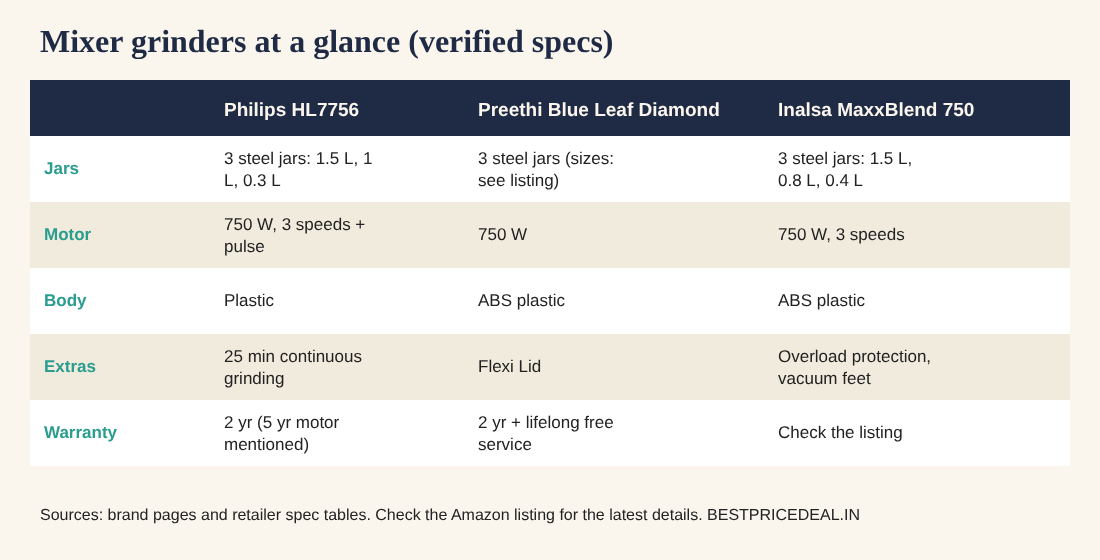
Philips lists this model with three food-grade stainless steel jars of 1.5 litre, 1 litre and 0.3 litre. The 1 litre jar is the dry-grinding one and comes with an anti-spill lid, which is handy for masala and coffee beans that like to puff out of the lid. There are three speeds plus a pulse button, and the brand says it can grind continuously for 25 minutes, even with something tough like black gram dal. For idli and vada batter, that is the claim that matters.
What I liked on paper: dishwasher-safe parts, a 1.2 m cord, and a motor warranty that Philips describes as five years, with two years listed in the specifications. The body is plastic and the whole unit weighs about 3 kg, so it will not stay planted like a heavy mixer. One thing to know before you buy is that the blades are non-removable, which means you cannot take them out for deep cleaning.
It suits a family that grinds batter or masala regularly and wants a long-running motor. It is less suitable if you want a juicer jar, because none is listed.
Preethi Blue Leaf Diamond (3 jars, 750 W)
Preethi is a long-established kitchen brand in India. Its own store page lists three stainless steel jars, stainless steel blades, an ABS plastic body and a Flexi Lid. The Flexi Lid is a flexible lid designed to make it easier to fit and remove. The company mentions grinding masalas, chutneys and batters as its intended use.
The reason to look at this one is the support. Preethi offers a two-year warranty and says it provides lifelong free service. If you have ever waited weeks for a repair on a brand with few service centres, you know that counts for something. The store page does not list jar capacities, motor RPM or any continuous-run time, so I cannot tell you how it compares on those. A few buyers on the brand’s own store mention noise and a light body, though the review count there is small, so treat it as a hint, not a verdict.
It suits someone who values service and a familiar brand over a list of features. Skip it if you need exact jar sizes before buying; check the Amazon listing for them.
Inalsa MaxxBlend 750 (3 jars, 750 W)
Of the three, Inalsa has the most detailed specification table. The retailer page I read lists a 1.5 litre liquidising jar, a 0.8 litre dry-grinding jar and a chutney jar (0.4 litre in the table, though the description says 0.3 litre, so the page contradicts itself). The jars and blades are stainless steel and the body is ABS plastic.
There are three speed settings, and the safety and stability list is practical: overload protection, vacuum feet, an anti-skid base, concealed bushes and nylon couplers. Nylon couplers are a good thing to have because they are the part that wears out first in most mixers and they are cheaper to replace than the motor shaft.
The gap is the warranty. The page I read does not state a period and only mentions a warranty card in the box. Before you order, look at the Amazon listing for the warranty length and who handles service. It suits a buyer who wants a larger dry-grinding jar and sensible safety features. It is a weaker choice if after-sales support is your first concern.
How to choose
Start with what you grind most. If it is wet batter, the motor’s ability to run for a long stretch matters more than the wattage printed on the box. Philips is the only one here that states a continuous-grinding figure. If it is dry masala and spices, look at the dry jar’s size and whether the lid seals well. A bigger dry jar saves you from grinding in three small batches.
Next, look at jar sizes in the Amazon listing, not only the number of jars. Three jars from one brand can mean 1.5, 1 and 0.3 litres, and from another 1.5, 0.8 and 0.4. For a family of four, a 1.5 litre jar is enough for batter, but a 0.3 litre chutney jar fills up fast if you make coconut chutney for guests.
Then read the warranty line. Motor warranty and body warranty are often different, and the period printed in a title may not cover jars, blades or couplers. Check who does the service in your city. A mixer with a good warranty and no service centre nearby is hard to use.
Finally, check the reviews on the Amazon listing itself, filtered for recent ones. Look for comments on noise, leaks from jar lids, and how the product is holding up after six months. Prices of all three move around, so check the current price on Amazon on the day you buy, and compare it against what you are willing to spend before the festive rush, rather than reacting to a banner.
If you are also stocking the kitchen for the colder months, our posts on home and kitchen lightning deals and storage geysers compared may be useful.
A mixer grinder is a machine you will use almost every day for years, so it is worth spending twenty minutes on the specifications now. Pick the one whose weak spot you can live with, whether that is the plastic body, the missing capacity figures or the unstated warranty, and the rest usually takes care of itself.