 BestPriceDeal.in

A lot of families end up buying a blood pressure monitor after a doctor’s visit, when someone is told to “keep a check at home” and nobody knows which machine to pick. The shelves are full of near-identical boxes. The Omron HEM-7120 is one of the names that keeps coming up, so here is what the brand’s specifications say about it, and who it makes sense for. This write-up is based on Omron’s India product page plus retailer spec pages and the manual summary, not on hands-on use.
What the HEM-7120 is
It is a fully automatic upper-arm monitor. You wrap the cuff, press one button, and it inflates by itself and shows systolic pressure, diastolic pressure and pulse on one screen. Omron describes its IntelliSense technology as picking the inflation pressure for you, so there is nothing to pre-set and no need to pump a bulb.
It measures using the oscillometric method, the same basic principle used by most home arm monitors.
Specifications we could confirm
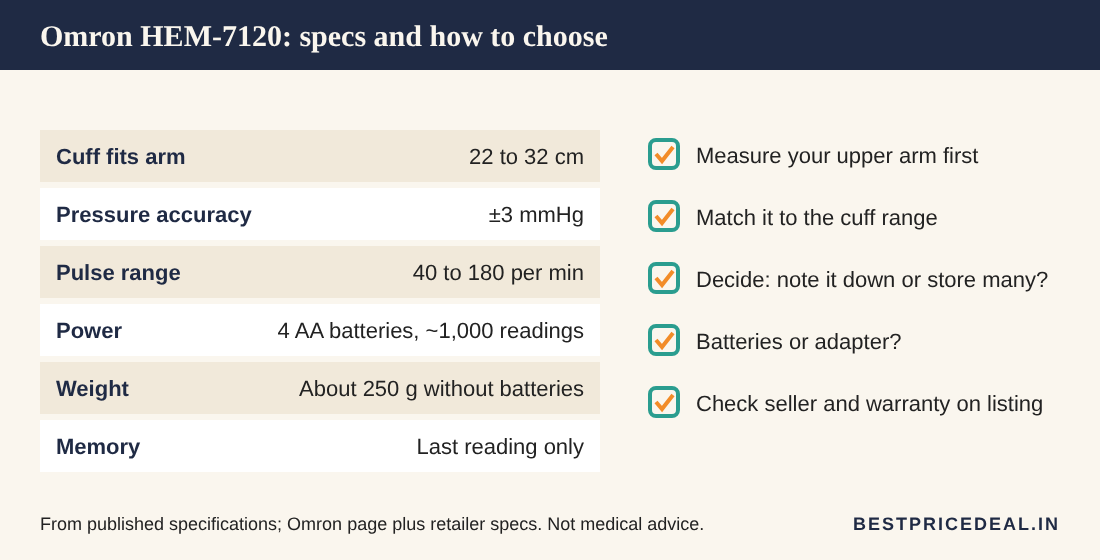
- Cuff fits an arm circumference of 22 to 32 cm; Omron lists a separate small cuff (17 to 22 cm) as an option
- Pressure accuracy of plus or minus 3 mmHg, pulse accuracy of plus or minus 5 percent of the reading
- Pulse range of 40 to 180 beats per minute
- Powered by 4 AA batteries, rated for about 1,000 measurements (retailer and manual sources); the AC adapter is sold separately
- About 250 g without batteries, roughly 103 x 80 x 129 mm
- Icons for irregular heartbeat, body movement, correct cuff wrap, and a high-reading indicator that flags readings above 135 systolic or 85 diastolic
- Memory for the last reading only, and one user, according to Omron’s page
- No Bluetooth
Accuracy, weight and battery life come from retailer and manual pages, because Omron’s own page does not state them. Warranty periods are listed differently by different sellers, and Omron’s page does not give one, so check the warranty on the listing you buy from.
Pros
The one-button operation is the biggest plus. An older parent who is uncomfortable with gadgets can use it without a manual once the cuff habit is learned. The “OK” cuff-wrap icon is a small thing that helps, because a loose cuff is a common cause of a wrong reading.
The body-movement and irregular-heartbeat icons are useful too. If a reading is disturbed because you spoke or shifted, the device tells you, and you repeat it instead of writing down a bad number.
Four AA batteries giving around a thousand readings means you are not hunting for a charger. It is also light enough to carry to a relative’s house.
Cons
The cuff covers 22 to 32 cm. If the upper arm is larger than that, this model is the wrong one; a different cuff size is needed. Measure before buying.
Memory is limited to the last reading and it is a one-user model, so anyone who wants a long history, separate profiles or readings synced to a phone should look at a different model. Keep a paper log.
It is a basic machine. Omron lists no Bluetooth, and there is no app or multi-user storage.
Who it suits
It suits a household where one or two people need a simple home check and a doctor has already advised monitoring. It also works as a second device for a parent living elsewhere. It does not replace a medical visit, and the manual itself says to consult a doctor if the irregular heartbeat icon appears often.
Who should skip it
Skip it if the upper arm is bigger than 32 cm, if you want data on your phone, or if several family members want their readings stored separately. If the arm is smaller than 22 cm, Omron’s optional small cuff may be the answer, but check that it suits your arm. A wrist model is a different product category and not a substitute.
How to choose a home BP monitor
Start with the arm. Measure around the upper arm and compare it with the cuff range printed in the specifications. Everything else matters less than a cuff that fits.
Next, decide what you will actually use. If you only need a number in the moment and will write it down, a basic model like this is enough. If you want trends over weeks, look for models that store many readings.
Check how it is powered. Batteries are simpler for travel, an adapter is better for daily use at one table.
Finally, check the seller and the warranty terms on the listing you are buying from, and keep the invoice.
Using it properly
The manual describes sitting on a chair with feet flat, resting the arm on a table so the cuff is at heart level, and wrapping the cuff about 1 to 2 cm above the elbow, with the air tube running down the centre of the arm. Stay still and do not talk while it measures. The manual does not give a recommended time of day or a rest period, so ask your doctor what routine suits you.
FAQ
Is the Omron HEM-7120 good for home use? Based on its specifications it is designed for home use: one-touch operation, a cuff for 22 to 32 cm arms, and icons that flag movement and cuff fit.
Does the HEM-7120 need batteries? It runs on 4 AA batteries, rated for about 1,000 measurements. The AC adapter is sold separately. Omron’s page lists the monitor and cuff as the contents and does not mention batteries, while one retailer says batteries are included, so check the listing.
How many readings does it store? Only the last reading, and it supports one user.
Can it replace a doctor’s check? No. A home monitor helps you track readings between visits. Ask your doctor how to interpret them.
You can compare other home picks on our Health & Beauty page, and if winter air is a worry at home, see our air purifier comparison and the room heater roundup.