 BestPriceDeal.in
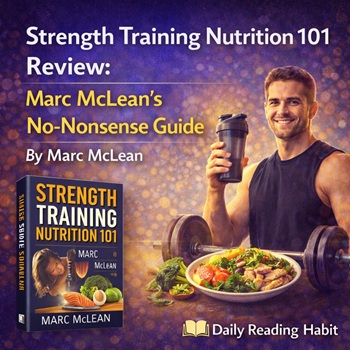
Strength Training Nutrition 101 by Marc McLean Review: Simple Advice From Someone Who Needed It Himself
There’s a detail about Marc McLean that the usual summaries of this book skip entirely, and it actually explains a lot about why the book reads the way it does: before he was a personal training and nutrition coach, McLean dealt with serious digestive health issues himself — enough that he later wrote separate books specifically about managing ulcerative colitis and IBS naturally, and even hosts a podcast on gut healing. A guy who’s had to rebuild his own relationship with food from a place of genuine difficulty writes a very different “eat simply” book than someone who’s never had a complicated reason to overthink meals.
That context matters, because the whole pitch of this book is refusing to make nutrition complicated — and it reads like someone who’s actually lived the alternative, not someone repeating gym-forum wisdom secondhand.
What’s Actually Different Here
McLean, based in Loch Lomond, Scotland, has spent two decades coaching people on strength training, and this book is built around what he calls his “7 Golden Rules of Clean Eating” — a real, specific numbered system, not just a loose set of vibes about “eating whole foods.” He explicitly positions this against what he calls “bro-science”: the constantly shifting, contradictory advice (“carbs are the devil,” “eat six small meals a day”) that dominates gym culture and mostly just creates anxiety rather than results.
The book covers protein, carbs, and fat in plain language, walks through common supplement myths (his honest take: most pre-workouts, fat burners, and BCAAs aren’t doing what marketing claims, and only a small handful of supplements actually have real evidence behind them), and gives meal-prep frameworks rather than rigid recipes you have to follow exactly.
Where It Genuinely Delivers
If your problem is decision fatigue — you know roughly that protein matters and processed food is bad, but you’re paralyzed by conflicting internet advice — this book’s entire value proposition is cutting through that noise quickly. You could realistically read this in an afternoon and start eating differently that same evening, which is rare for a nutrition book; most pad themselves out with far more theory than anyone actually needs to act.
Where It’s Genuinely Limited
McLean is upfront about this himself, and it’s worth repeating rather than glossing over: this is explicitly not for competitive bodybuilders or anyone needing precise macro targeting for a show or elite performance. It’s a foundation, not an advanced manual. If you’re already tracking macros carefully and want to fine-tune body composition, this will feel too basic. It’s also light on actual recipes — you get frameworks and principles, not a cookbook, so pair it with your own recipe sources if that’s what you need.
Who Should Actually Read This
- Anyone newer to strength training who feels overwhelmed by contradictory nutrition advice online.
- People who’ve been burned by expensive supplement stacks and want an honest, low-hype take on what’s actually worth buying.
- Readers who want something they can finish and act on same-day, not a dense reference manual.
Who Should Skip It
- Competitive bodybuilders or advanced lifters needing precise macro periodization — this stays intentionally basic.
- Anyone specifically looking for a recipe book rather than a principles-and-frameworks guide.
Verdict: 4.5/5
Not a 5 only because it does exactly what it promises and nothing more — but that’s also precisely the point of a “101” book, and it succeeds at being genuinely usable rather than impressive-sounding. Written by someone whose own relationship with food wasn’t always simple, which shows in how little this book tries to overcomplicate yours.
Buy Strength Training Nutrition 101 here: GET DEAL — ₹761 (was ₹1,321)